Best Residential Areas to Live in Whitefield Bangalore: Is Whitefield an Expensive Area?
September 25, 2026
Choosing the right residential area in Whitefield can make a major difference to your daily commute, lifestyle, budget, and long-term…

The first time I heard my contractor talking about “FSI limits” on a site visit, I nodded along like I knew exactly what he meant while secretly pulling out my phone to Google it under the table. I thought, “It’s my land, I should be able to build as high as I want, right?” Wrong. Very wrong.
If you are planning to build your dream home or invest in a new apartment in 2026, you absolutely need to understand what is fsi in real estate. It’s basically the “rulebook” that tells you how much actual building space you can squeeze out of your plot. Without knowing this, you might end up buying a massive piece of land only to realize the government will only let you build a tiny cottage on it. Let’s break down this.
First things first, the fsi full form in construction stands for Floor Space Index. In some cities like Delhi or Bangalore, you might also hear it called FAR (Floor Area Ratio).
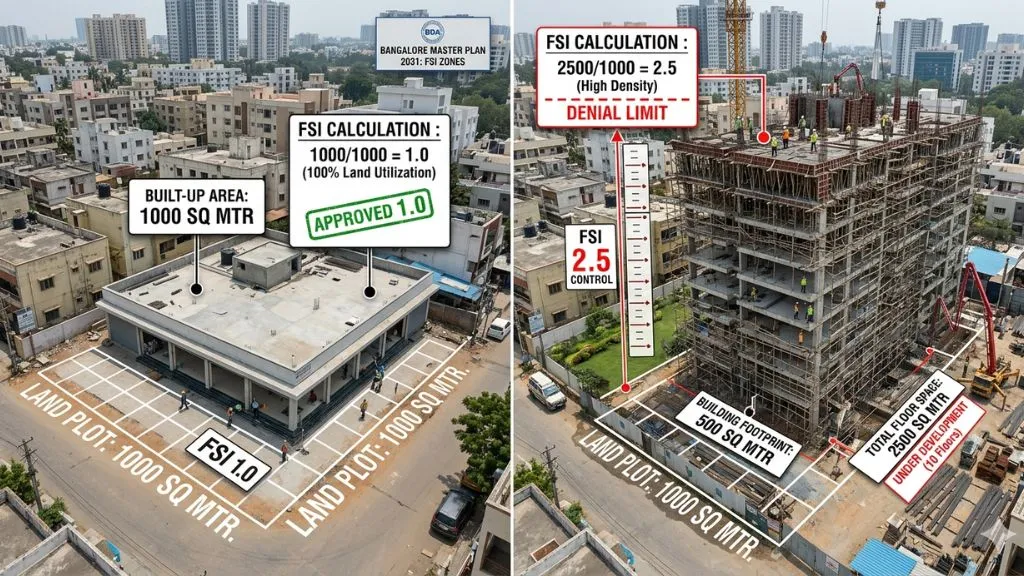
Essentially, fsi meaning in real estate is the ratio between the total built-up area of a building and the actual size of the plot it stands on. It’s the government’s way of controlling how crowded a neighborhood gets. If everyone built 50-story skyscrapers on small lanes, the sewage, roads, and electricity would just collapse. So, the local municipal body (like the BMC in Mumbai or BDA in Bangalore) sets a limit to keep things disciplined.
Now, don’t panic, the math is actually pretty simple. You don’t need a PhD to figure out how to calculate fsi area.
The fsi calculation formula is:
FSI = (Total Floor Area of all floors) / (Total Plot Area)
If you want to express it as a percentage (which is common in India), you just multiply by 100.
Suppose you have a 1,000 sq. ft. plot.
Every city has its own vibe, and every city has its own FSI. Usually, the more crowded the city, the higher the FSI allowed to accommodate more people.
| City | Typical FSI / FAR Range | Notes |
| Mumbai | 0.5 to 1.33+ | Higher in “Island City” than suburbs. |
| Hyderabad | 6.0 to 7.0 | No “upper cap” makes it a high-rise paradise! |
| Bangalore | 1.75 to 3.35 | Depends on road width and “zone.” |
| Delhi | 1.2 to 3.5 | Varies wildly based on plot size. |
| Pune | 1.5 to 2.5 | Can go up to 5.5 for slum redevelopment. |
I once saw a builder in Chennai building two extra floors that seemed to defy the local limit. I asked him how, and he whispered two words: Premium FSI.
If your plot is right next to a wide main road (usually 30 feet or wider), the government allows you to “buy” extra building space. You pay a fee to the municipal body, and they let you exceed the normal limit.
This is why houses on main roads are always more expensive, they have the potential to be much bigger!
You might think, “I’m just buying a flat, why do I care about fsi meaning in construction?” Well, it affects your wallet more than you think:
Understanding what is fsi in real estate is like knowing the ingredients of a dish before you eat it. It tells you exactly what you are getting for your money. If you are buying an independent house, always do the how to calculate fsi area check yourself before finalizing the architect’s plan.
Building or buying a home is a once-in-a-lifetime thing for most of us, don’t let a “small math error” like FSI ruin your peace of mind.