Best Residential Areas to Live in Whitefield Bangalore: Is Whitefield an Expensive Area?
September 25, 2026
Choosing the right residential area in Whitefield can make a major difference to your daily commute, lifestyle, budget, and long-term…

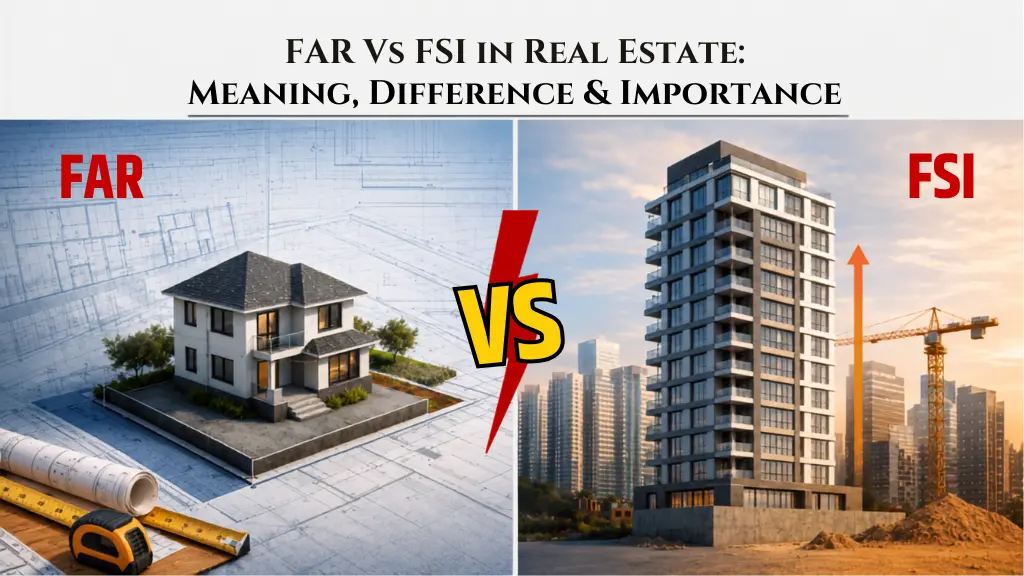
Ever sat down with a property broker or builder and felt like they were speaking a completely different language? You are looking at a beautiful brochure for a new apartment project, and suddenly they throw words like “FSI constraints” or “permissible FAR limits” right at your face.
You nod along because you don’t want to look clueless, but inside you’re thinking, what on earth does any of this actually mean?
If you are trying to buy a house, invest in a plot, or just figure out why some builders can build massive 40-story towers while others stop at just 4 floors, you need to understand these metrics. Let’s unwrap the mystery behind these terms.
Let’s start with the absolute basics. What do these acronyms stand for when you’re looking at property documents?
(By the way, if you ever look up far full form in finance, it means something completely different like ‘False Acceptance Rate’ or ‘Floor Broker’, so don’t let Google search confuse you! We are sticking strictly to far real estate today).
Here is the funniest part about the whole difference between fsi and far: there is literally no technical difference at all.
They are exactly the same concept masquerading under two different names. Think of it like “football” and “soccer.” In India, our local municipal bodies and RERA documents almost always use the term FSI. Internationally, like if you look at real estate planning in the US, UK, or Singapore, they prefer calling it FAR.
No matter which word you use, both metrics tell you the exact same thing: how much total floor area a builder can legally construct on a specific piece of land.
Because math can get boring real quick, let’s use a super simple real-world example.
Imagine you own a nice plot of land in a developing area that measures exactly 1,000 square feet. The local municipal authority tells you that the permissible index for your street is 2.0.
The formula used by city planners is incredibly basic:

So, if your index limit is 2.0, your calculation looks like this:

Now, how you actually use that 2,000 square feet of total floor space is where things get interesting. You have total flexibility depending on local height restrictions:
See? The final total constructed area stays exactly at 2,000 square feet no matter which option you pick. That is the core far meaning in real estate simplified.
To make this completely scannable for your next property meeting, here is how the two terms stack up side-by-side:
| Feature/Parameter | Floor Space Index (FSI) | Floor Area Ratio (FAR) |
| How It’s Expressed | Usually written as a decimal or ratio (e.g., 1.5, 2.5, 3.0) | Often written as a percentage in international markets (e.g., 150%, 250%) |
| Geographic Popularity | The go-to term across India (Mumbai, Bangalore, Delhi-NCR) | Used globally and by international urban planning boards |
| Legal Framework | Found in local municipal bye-laws and structural regulations | Found in global zoning laws and master development plans |
| Core Function | Controls building density to ensure public infrastructure can handle the crowd | Same—prevents over-building on a tiny piece of land |
You might be thinking, “Hey, I’m just buying a ready-to-move-in 3 BHK apartment, why should I care about what the builder did with the land indices?”
Well, it impacts your daily lifestyle way more than you think. Here is exactly why you need to keep an eye on these numbers:
If a residential project has a super high FSI or FAR, it means the builder is allowed to pack a ton of apartments onto that single piece of land. That means more families living in the same complex, crowded elevators, long wait times at the gym, and a packed swimming pool on weekends. Low index numbers mean fewer apartments, more breathing room, and better privacy.
When authorities enforce a strict limit, builders cannot just cover the whole plot with concrete. They are forced to leave open green spaces, parks, and wide walking paths around the towers. This directly affects how much natural sunlight and fresh air enters your living room window.
This is a massive point that most buyers completely miss. If a locality gets a sudden increase in its government-approved FSI limits due to a new metro line coming up nearby, the value of the land shoots up instantly. Why? Because developers can now build much taller buildings on that exact same plot, making old properties prime targets for lucrative redevelopment deals.
You can’t just choose a high number because you want a bigger house. Municipal bodies change these limits constantly based on the local environment:
At the end of the day, do not let real estate agents confuse you with complicated terminology. Just remember that FSI and FAR are two sides of the exact same coin. One is the local Indian phrase, and the other is used internationally.
When you are house hunting, always ask the builder what the project’s sanctioned index is. A lower number usually means a premium, peaceful lifestyle with plenty of open space, while a higher number means a busy, high-density community. Choose what fits your budget and lifestyle best!