Floor Rise Charges on Flats: Meaning, RERA Rules and How to Calculate it?
November 24, 2026
When buying an apartment in a multi-storey building, you may notice that flats on higher floors cost more than similar…

Installing solar panels in an apartment is possible even if you do not own a private rooftop. Apartment residents in India can explore shared rooftop solar systems for common facilities, individual rooftop installations where permitted, and smaller balcony-mounted systems. Housing societies may also consider community-level solar arrangements, depending on local electricity regulations.
However, the right option depends on rooftop availability, housing society permissions, electricity meter arrangements, installation costs and government subsidy eligibility. A shared solar system, for example, may reduce the electricity expenses of lifts, water pumps and common lighting, while an individual system may help offset a household’s own electricity consumption.
This guide explains the different solar panel options for apartments, their approximate costs, available subsidies, installation requirements and practical limitations to help residents decide whether solar power is suitable for their building.
Yes, but installing solar panels for flats is not as straightforward as it is for independent houses.
In most apartment buildings, rooftops are common areas managed by the Resident Welfare Association (RWA) or apartment association. You cannot simply occupy a portion of the terrace and install panels without approval.
Other challenges include:
The good news? You still have a few ways to make solar work.
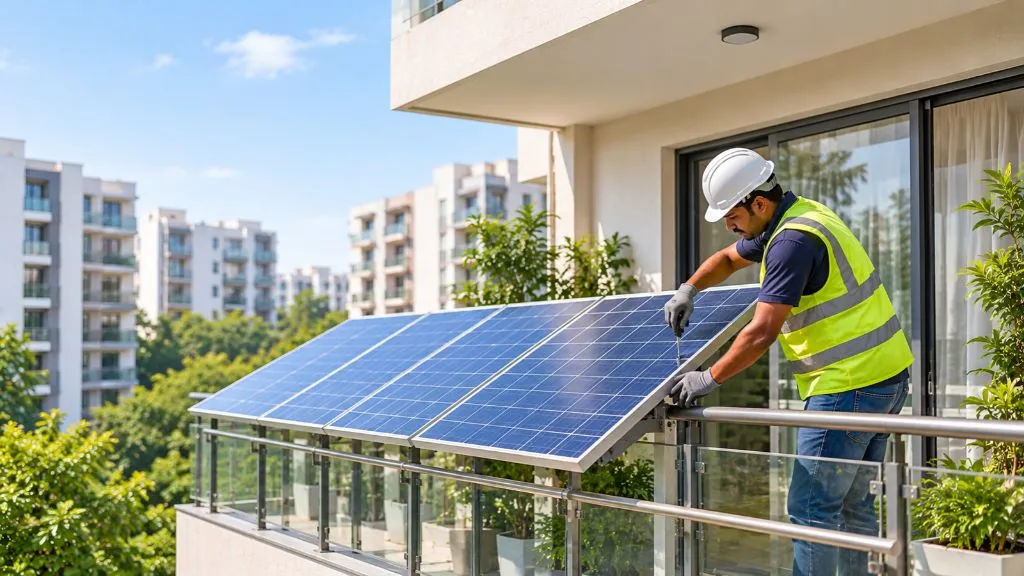
Not every flat needs the same setup. Here are four options to consider.
This is one of the most practical options for apartment communities.
The housing society installs solar panels on the common rooftop. The electricity generated is used to power shared facilities such as:
Why consider it? The installation cost is shared, and residents can benefit from reduced common electricity expenses and, potentially, lower maintenance charges.
Limitation: It requires sufficient rooftop space, society approval and an agreement on how the savings will be distributed.
If your apartment association allows individual installations and there is sufficient space, you can explore a separate rooftop solar system connected to your flat’s electricity meter.
This option can help reduce your personal electricity consumption, especially if you regularly use air conditioners, washing machines and other power-hungry appliances.
Limitation: Not every resident gets access to the rooftop. Installation also depends on structural suitability, permissions and net-metering rules.
No rooftop access? Balcony-mounted solar panels may seem like an easy alternative.
These smaller systems use panels mounted on suitable balcony structures to generate electricity for household use.
However, solar panels for apartment balcony installations have limitations. Balconies may receive only a few hours of direct sunlight, and railings may not support the additional load.
Before installing, check:
Plug-and-play balcony solar systems are not automatically approved for use in India. Check local DISCOM requirements before purchasing one.
What if your apartment has no suitable rooftop at all?
Community solar and virtual net metering are possible models worth exploring. A shared solar installation generates electricity at a separate location, and participating consumers receive credits against their electricity consumption.
However, virtual net metering is not uniformly available across India. Its availability and billing arrangements depend on state regulations and the local DISCOM.
The cost of solar panels for flats depends on system capacity, panel quality, installation requirements and available subsidies.
Here are broad indicative estimates to help you plan:
| Solar option | Approximate cost |
| Balcony solar kit | ₹45,000–₹90,000 |
| Individual 1 kW rooftop system | ₹50,000–₹70,000 |
| Individual 3 kW rooftop system | ₹1.5–₹2.1 lakh |
| Shared society rooftop system | Depends on capacity and number of flats |
Installing solar panels on a society rooftop does not automatically reduce every resident’s individual electricity bill. If the system supplies common-area electricity, the benefit generally comes through lower common electricity expenses or maintenance costs.
Yes. Under the PM Surya Ghar Muft Bijli Yojana, eligible residential households can receive central financial assistance:
Eligible RWAs and housing societies can also receive assistance for common-area solar installations, subject to scheme conditions. Check the official PM Surya Ghar portal for eligibility and application details.
Before investing, keep these practical limitations in mind:
Yes, provided the installation suits your building and electricity needs.
For most apartment communities, shared rooftop solar is a practical starting point because it reduces common-area electricity expenses. Individual systems may also work where suitable space and permissions are available.
Before investing, compare installation costs, expected savings, subsidy eligibility and maintenance requirements. Solar is a long-term decision, so getting the basics right matters more than simply choosing the cheapest system.